Painted Flat or Found Room? Two Approaches to Stage Space
Painted flat or found room? Compare how a built scenic surface and an existing interior establish place, guide attention, and shape a performance.
Should you use a painted flat or a found room to make a stage audience understand where a scene happens? That choice changes more than the backdrop: it affects how much the audience can imagine, where their eyes settle, and how performers relate to the space around them.
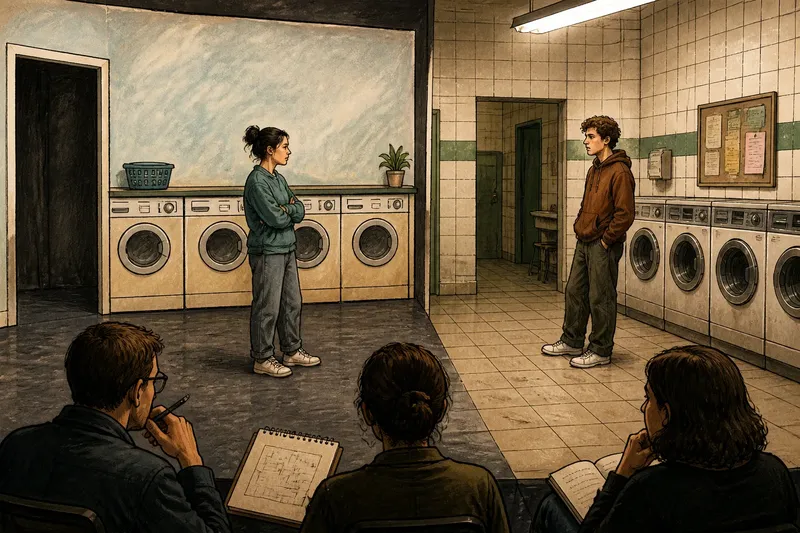
Consider an invented production of a short play set in a neighborhood laundromat after closing. The director wants the room to feel familiar but slightly lonely, with two characters speaking beside a row of machines. The team has access to a plain black-box stage and, as a separate possibility, an unused tiled room in a community building. Neither option is automatically more convincing. Each asks the audience to read place in a different way.
The imagined laundromat
In this hypothetical situation, the design team first identifies what the scene needs the audience to notice. The characters are waiting for a cycle to finish, but the conversation is really about one of them leaving town. The space should make waiting visible without turning the machines into the main event.
The team can build a scenic surface: a painted flat suggesting a back wall, perhaps with a counter, a window, and a few graphic machine fronts. Or it can present the found tiled room with its actual grout lines, door, and built-in surfaces. Both can suggest a laundromat, but they do not deliver the same kind of evidence.
A painted flat offers a composed image. A found room offers the marks and proportions of a place that already exists. The useful question is not which is more realistic; it is which kind of reality supports this particular scene.
What a painted flat declares
A flat is a constructed scenic surface, often made to stand upright and dressed with paint or other finish. It can be a wall, a fragment of an interior, or a deliberately simplified picture of one. Its edges and omissions are part of the design: a painted window need not open, and a counter can stop exactly where the stage picture needs it to.
For the laundromat scene, the design could use a broad, pale wall with a painted row of circular machine doors. The circles immediately identify the setting, while a dark doorway at one side gives the characters a clear point of entry and exit. Since the background is composed rather than complete, the audience is invited to fill in the unseen parts of the room.
That simplification can help direct attention. The designer can leave visual quiet behind the actors, keep the strongest lines near the edges, and position the implied doorway where a late arrival will be easy to read. A flat can make the setting legible without making every surface compete with the performers.
It also lets the production choose its degree of detail. A few broad shapes may make the place feel like a memory or a theatrical shorthand; crisp labels and familiar tile patterns may move it closer to everyday observation. The audience sees a designed image, even if it reads as a recognizable room.
For the hypothetical production, the team imagines a subdued flat with just enough detail to establish the laundromat. The characters can stand in front of it without being swallowed by visual clutter. The setting becomes a frame for their conversation, not a second scene demanding attention.
What a found room supplies
A found room begins with existing architecture rather than a surface built to represent architecture. In the community building, the tiled walls, narrow entrance, and overhead fixtures already give the audience cues about the room’s function. Those cues may feel immediate because they are physical features, not painted suggestions.
The room can also carry incidental character. A worn patch beside the door, uneven tile, or an old noticeboard may imply regular use. Such details can make the place feel particular without requiring the design team to invent every mark. Yet this richness is not neutral: the audience may look at the noticeboard or the odd fixture instead of the actors.
Unlike a flat, an existing interior has proportions that were not necessarily chosen for a stage picture. A doorway may be too close to the acting area, a wall may create a visual dead end, or the room’s depth may make the performers appear isolated. In the invented scenario, the team would need to observe where a seated audience can see faces and whether the characters can occupy the room without blocking each other.
A found room may also bring practical constraints: its lighting, access, surfaces, or permitted use can affect how it is presented. Those conditions matter because a room that looks persuasive on arrival may not support a clear performance view. The team’s decision should follow the actual space and the production’s needs, with any building or use restrictions checked with the responsible venue.
For this scene, the room’s tiled walls could make the laundromat feel unmistakably ordinary. But if the characters have to stand in a narrow strip to stay visible, the room’s authenticity may work against the scene. The team would need to decide whether that closeness feels like useful pressure or simply makes the action hard to read.
How attention moves
Stage space directs attention through contrast, shape, depth, and the paths available to performers. A painted flat can be designed around those paths. The entrance can be placed at the point where the audience expects it, and the background can be kept quiet where an important pause or gesture needs room.
A found room directs attention through its existing features. A bright doorway, reflective surface, or strong line of tiles may pull the eye whether or not the production intends it. The team can compose the performance within the room, but it has less freedom to redraw the architecture.
In the imagined laundromat, the quietest beat comes when one character stops speaking and listens to the machine. With a flat, the designers might leave open wall behind that performer, making the stillness easy to read. In the found room, the same pause might land against a busy noticeboard or a bright doorway; the team would need to choose a position where the background does not compete.
Attention is not only visual. A room’s apparent depth can make a character’s distance from another feel emotionally significant. A shallow, graphic flat may make the scene feel more like a composed tableau. Neither effect is inherently better; they communicate different relationships between the people and their surroundings.
Choosing for the scene
As the team weighs the two options, it asks what the audience must understand at a glance and what can remain suggested. If the setting needs to be recognizable from a simple image, the painted flat can provide a clean, controlled cue. If the characters’ relationship to a real, enclosed room matters, the found interior may contribute more than a painted imitation could.
The team also considers how the actors will use the space. Can they cross naturally? Is there a place to pause without blocking a partner? Does the setting offer a useful threshold, or does it force everyone into one visible patch? These questions connect scenic choice to performance rather than treating the background as decoration.
Say the director decides that the characters should seem trapped in a routine they know too well. The team chooses the found tiled room, but treats the doorway as the visual center: one character stays near it while the other waits beside the implied machines. The expected result is a readable picture of one person poised to leave and the other still bound to the room, with the existing architecture reinforcing that tension.
Now imagine the director instead wants the audience to focus on the conversation as an almost private memory. The flat may suit that aim better. A simplified wall and a few recognizable machine circles can establish the place while leaving the performers in a calmer visual field.
These are not claims that one option always produces a particular emotion. They show how the same scene can be framed differently: an existing room makes its own material presence part of the performance, while a flat lets the production select and arrange the evidence of place.
Questions about stage space?
What is a scenic flat?
A scenic flat is a constructed, usually lightweight stage surface finished to represent a wall, interior, or other visual element. It can suggest a complete location without reproducing every feature of one.
When does a found room work best?
A found room can suit a scene when its actual architecture contributes to the story and the performance remains clearly visible within it. Existing details are useful only when they support, rather than distract from, the intended focus.
Can a flat look realistic?
Yes. Paint, texture, and carefully chosen details can make a flat read as a familiar place, though its edges and omissions remain part of the theatrical image. Realism is a design choice, not a requirement to reproduce every object.
How should a team compare the options?
Look at the scene from the audience’s viewpoint and ask what each space makes easy to understand. Compare the entrance, actor positions, background distractions, and the amount of the location that needs to be shown.
The final stage picture
In the invented production, the team settles on the found room after checking that the actors remain visible and that the doorway supports the scene’s departure motif. They keep the performance area clear of unrelated visual activity, so the tile reads as atmosphere rather than an invitation to inspect every corner. The result is an ordinary interior made theatrically specific by where the performers stand and how they use its threshold.
A different production could reasonably choose the flat and gain a more deliberate, open image. The most useful comparison is the one that asks what the audience should notice first, what the space should imply, and how much the architecture should participate in the action. For a painted flat or found room, that decision turns a location into a point of view.