The Shape of a Sleeve: Reading Character Through Costume
Read character through costume by tracking sleeve shape, fit, and movement, so you can spot what a performer’s clothing communicates before a line is spoken.
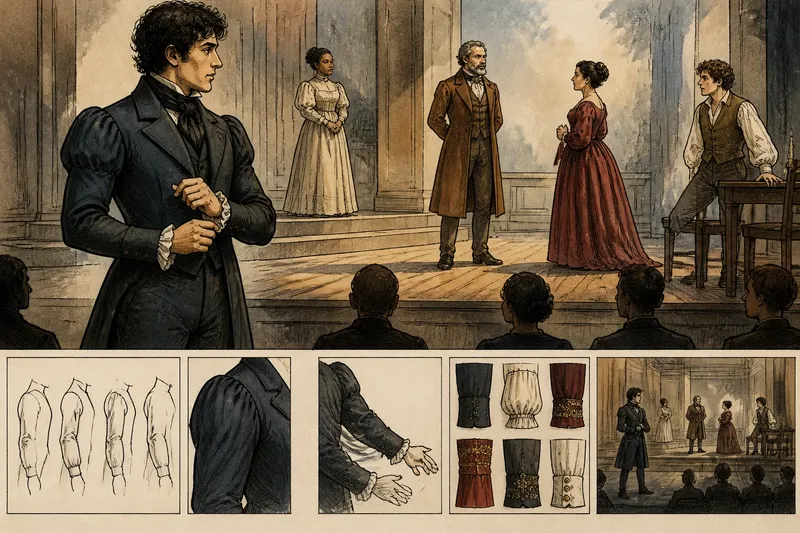
How can you read a character through costume before the performer speaks? Start with the sleeve: its outline, its fit at the shoulder and wrist, and the way it shifts when the actor moves. A puffed sleeve, a close cuff, or fabric that catches at the elbow can suggest possibilities, but none has a fixed meaning on its own.
For a useful reading, watch the costume in sequence rather than assigning a personality to one detail. Notice what the garment invites or resists, then compare that impression with the performer’s gestures and the surrounding design. The point is not to decode a secret message; it is to describe how clothing shapes what an audience can see.
Begin with the outline
Look at the performer from a distance, where small trim and stitching disappear. Is the sleeve narrow and close to the arm, rounded at the shoulder, broad through the forearm, or loose enough to form a visible shape away from the body? Note the overall proportion beside the torso and the other costume pieces.
Silhouette can organize attention. A sleeve that extends beyond the shoulder may make the upper body read as expansive, while a close sleeve can keep the line compact. Those observations describe appearance, not character traits. A broad outline might support authority in one scene, but it could also be ceremonial, comic, protective, or simply part of a period style.
Try sketching only the contour, or describe it in plain words: “rounded shoulder, tapering forearm.” That gives you a reliable record before interpretation begins.
Check the fit
Next, look at where the sleeve meets the body. Does the shoulder seam sit near the shoulder, drop down the arm, or disappear under a shaped yoke? Does the fabric lie smoothly, pull across the upper arm, or gather near the cuff? Check whether the sleeve looks tailored, softened, oversized, or deliberately restrictive.
Fit can make a gesture appear easy or effortful. A snug cuff may frame a hand and make small movements conspicuous; a roomy sleeve may blur the arm’s outline or create a swish. But the same visual effect can come from different causes, such as a character’s taste, a costume convention, or a practical choice for the scene. Keep those possibilities open until you see the garment in use.
Compare both arms if you can. An asymmetrical sleeve may draw attention to a particular side, though the performer’s blocking or a layered garment may explain the difference.
Follow the movement
Watch the performer reach, turn, sit, fold their arms, and let their hands rest. The sleeve may slide, bunch, swing, stretch, or hold its shape. Observe whether it changes the visible path of the hand or makes an ordinary gesture larger, smaller, or harder to read from the audience.
Movement often clarifies what a static view cannot. A loose sleeve may trail behind an arm, making a turn feel more expansive; a structured sleeve may preserve its outline as the body changes direction. Neither effect dictates an emotion. Instead, ask what the fabric makes prominent: the hand, the shoulder, the full arm, or the space between arm and body.
Imagine a performer enters in a jacket with a firm shoulder and close cuffs, then repeatedly smooths one sleeve before addressing another character. You might note that the garment keeps the arm’s outline crisp while the repeated adjustment gives the hand a visible task. Whether that reads as composure, nerves, habit, or something else depends on the scene and what the performer does next.
Read the detail
After observing the shape and movement, inspect details that alter the sleeve’s visual weight. A row of buttons, piping, a contrasting lining, a gathered seam, or a patch can redirect the eye. Note where the detail sits and whether it appears clearly in the performance space or only at close range.
Material matters, too. Stiff fabric can hold a defined edge; soft cloth may collapse into folds. Sheer layers can make an arm partly visible, while a heavy cuff can give the wrist a strong boundary. These effects are visible properties, not automatic symbols. A bright cuff might be decorative, signal a uniform, or simply belong to a costume palette shared by the ensemble.
Look for repetition across the wardrobe. If several characters wear the same cuff treatment, it may establish a group style rather than reveal one person’s private character. If one sleeve is distinct, ask whether the difference is echoed elsewhere in that performer’s costume.
Compare the scene
Now place the sleeve in its immediate context. Compare it with the other characters’ clothing, the performer’s posture, and the scene’s staging. Is this silhouette unusual among the people onstage? Does the actor’s movement make its feature more noticeable, or does the lighting and distance soften it?
Keep your evidence specific. “The sleeve flares when the actor lifts an arm” is an observation. “The character is flamboyant” is an interpretation. You can connect them, but leave room for other readings and check whether the scene supports your idea through repeated behavior, costume changes, or relationships between characters.
A quick note can keep the distinction clear:
- Outline: Describe the sleeve’s shape from a distance.
- Fit: Record where it sits close, loose, or structured.
- Movement: Notice what changes during a gesture.
- Detail: Identify the feature that catches the eye.
- Context: Compare it with the performer and scene around it.
- Interpretation: Offer a reading that the visible evidence can support.
Questions about sleeves?
Can a sleeve reveal personality by itself?
It can contribute to an impression, but one clothing feature rarely settles a character reading. Treat it as a clue to consider alongside gesture, context, and the rest of the costume.
What if the sleeve barely moves?
Stillness is useful to observe: the sleeve may hold a sharp contour, conceal the arm, or make the hand stand out against the body. Check whether the performer’s posture or placement gives that still shape a particular emphasis.
How do I avoid assigning a fixed meaning?
Describe what you can see before naming what it might suggest. Then use tentative language, such as “could emphasize” or “seems to draw attention to,” and compare the idea with the rest of the scene.
Does stage distance change what matters?
Yes: broad shape and movement usually remain easier to read from farther away than fine stitching or small fastenings. At close range, those details may add another layer, but they should not replace the silhouette and action you can observe across the room.
Build a careful reading
When you write or talk about a costume, pair a visible detail with the moment that made it noticeable. “The loose cuff swings past the hand during the turn” gives a reader something concrete to picture; you can then say what that movement seems to emphasize without presenting your interpretation as a rule.
For a second look, follow the sleeve through a different kind of action: a quiet pause, a reach, or a change of direction. If the impression shifts, that is not a failure to decode the costume. It shows that a sleeve works in motion, with a performer and a scene, rather than as a standalone label.
Reading character through costume becomes more precise when you keep the observation and interpretation in view at the same time. Begin with the outline, track the fit and movement, and let the scene decide which possibilities deserve attention.